
Young Ladies
I love Tamara de Lempicka’s bold, unapologetic compositions that seem to pop out of the canvas in vivid colour. At first glance her Art Deco style appears to simplify reality with its clean lines, deep contrast and sculpted forms. A closer look deepens the experience as the eye is guided by dramatic shadows toward a brilliance of hue and impacting detail that give way to something larger than life.
For more information about the original artist see: https://tamaradelempicka.org/
My two oil studies are Lady with Gloves followed by Young Ladies
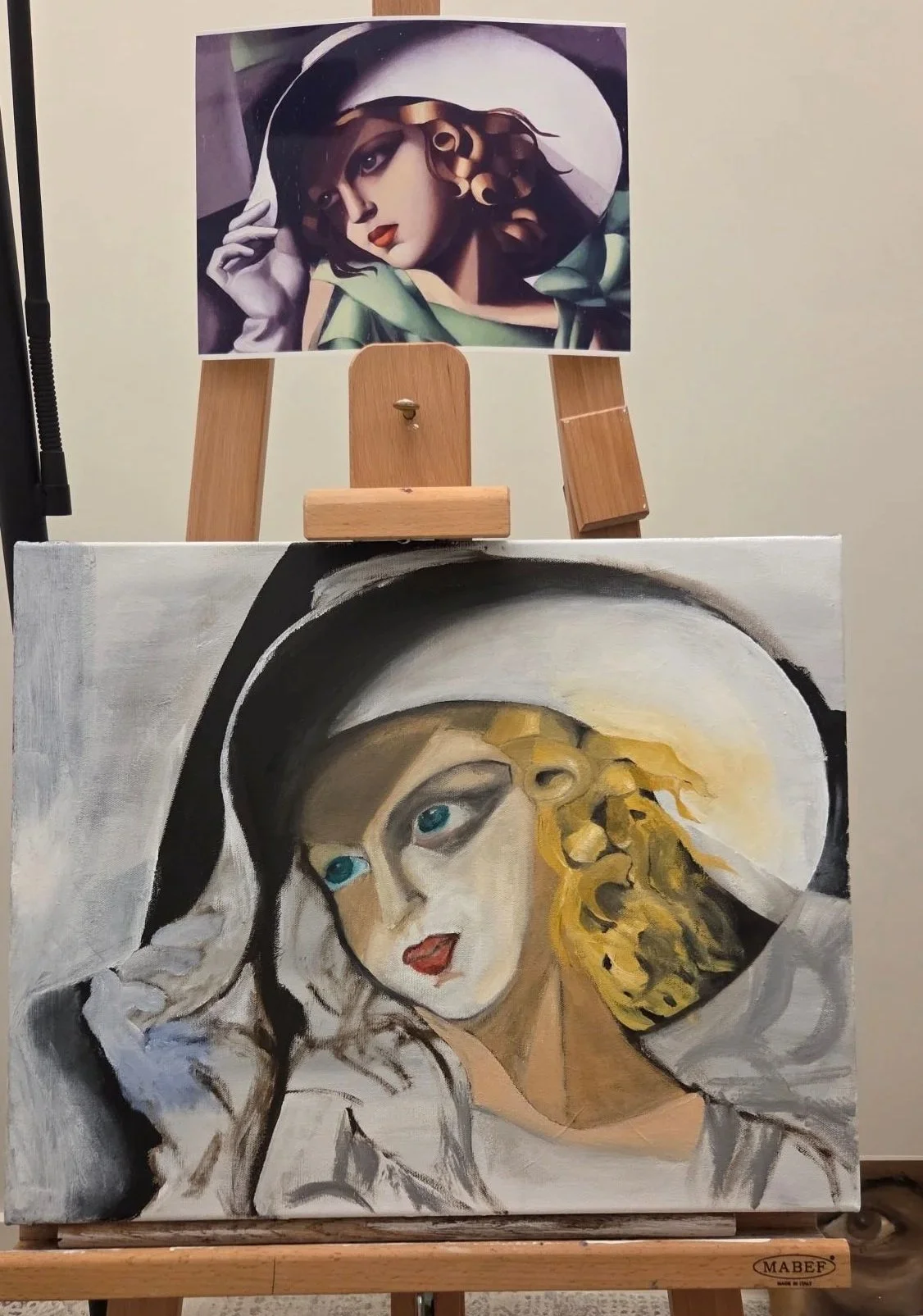
Lady with Gloves
Lady with Gloves
I soon got into trouble as too much thought and procrastination lead to impatience by the time I finally began to paint. Compounding this was the unforeseen upshift in discipline needed for the task. I had just completed a Renoir master study of the portrait of Jeanne Samary. With its loose brushstrokes and forgiving boundaries it was a joy to paint. With this study I struggled to garner the discipline and process needed for a much tighter precision.
Struggle with shadow began by poor planning as the face and neckline underpainting were painted at different times. I wanted the shadow around the neck to be warmer and transition cooler toward the forehead. But the underpaintings differed so much that I couldn’t achieve the right mixes of glaze to compensate for good harmony. In the end, I started anew by repainting the areas an opaque grey and took the penalty of waiting several days for it to dry.
The blonde hair is too yellow. At the top hairline I tried to match the reference shapes as best I could but lost focus as I neared the bottom half of the hairline. This too was repainted twice with a black mix (Ultramarine Blue + Burnt Umber).
The green dress base colour is Phthalo green with blue, yellow and white highlights. As I painted I became intrigued with the cubist patterns ornamenting the left shoulder of the subject’s dress. I enjoyed the freedom of pulling the hues of wet on wet paint giving depth to forms and carving to create or reinforce boundaries. This work influenced my repainting of the bottom hairline. This difference in style between the top and bottom hairline stings my eye whenever I look at the painting.
Finally, the curtain and shadow were glazed with a Dioxazine Purple and Alizarin Permanent for a harmonizing violet hue.
Young Ladies
Determined to be more disciplined with my next study, I began with a grisaille underpainting. This shifted my focus on shape and (grey) value to greatly simplify the layout of the composition. I used the Di Vinci Eye App set to break down values into five discreet steps as a guide. I manually transposed an 8×10 picture of the reference painting to a 16×20 prepared hardboard surface by transferring about 20 coordinate measurements. I began by painting a general outline in a light grey using the transferred coordinates as a guide.
Palette
For Ginger hair the basic colour was a mix of Burnt Sienna heavily tinted with Titanium White. Tone with a touch of Earth Red (Transparent Oxide Red) or brighten with a touch of Cadmium Red Light or Napthol Red. I sparingly brushed a light yellow or white wet on wet to brighten further.
For Blonde hair I used a subset of Ben Lustenhouwer’s palette: Ultramarine Blue, Alizarin Permanent, Earth Red, Cadmium Red Medium (a substitute for Deep), Raw Sienna, Yellow Ochre, Titanium White. Mauve was mixed with: Ultramine Blue + Alizarin (a Crimson) + White. Mauve was particularly useful as a compliment to knock down too yellow a colour.
For the Skin I wanted to use a minimalist “Zorn” (Anders Leonard Zorn) palette but the complexity of colour around the eyes and shadow made me shy away from the idea. I added Dioxazine Purple as a glaze to deepen colour of shadow around the eyes and nose.
The Dress flutes were a mix of Phthalo Green and Blue - transparent out of the tube and with a dab of the brush in Safflower oil made for a glass like glossy glaze. The (grey) values in the underpainting came through depending on the thickness and mix ratio of paint and medium. In the lightest areas I wiped off the glaze to allow the brightest underpaint values to show through.
Painting
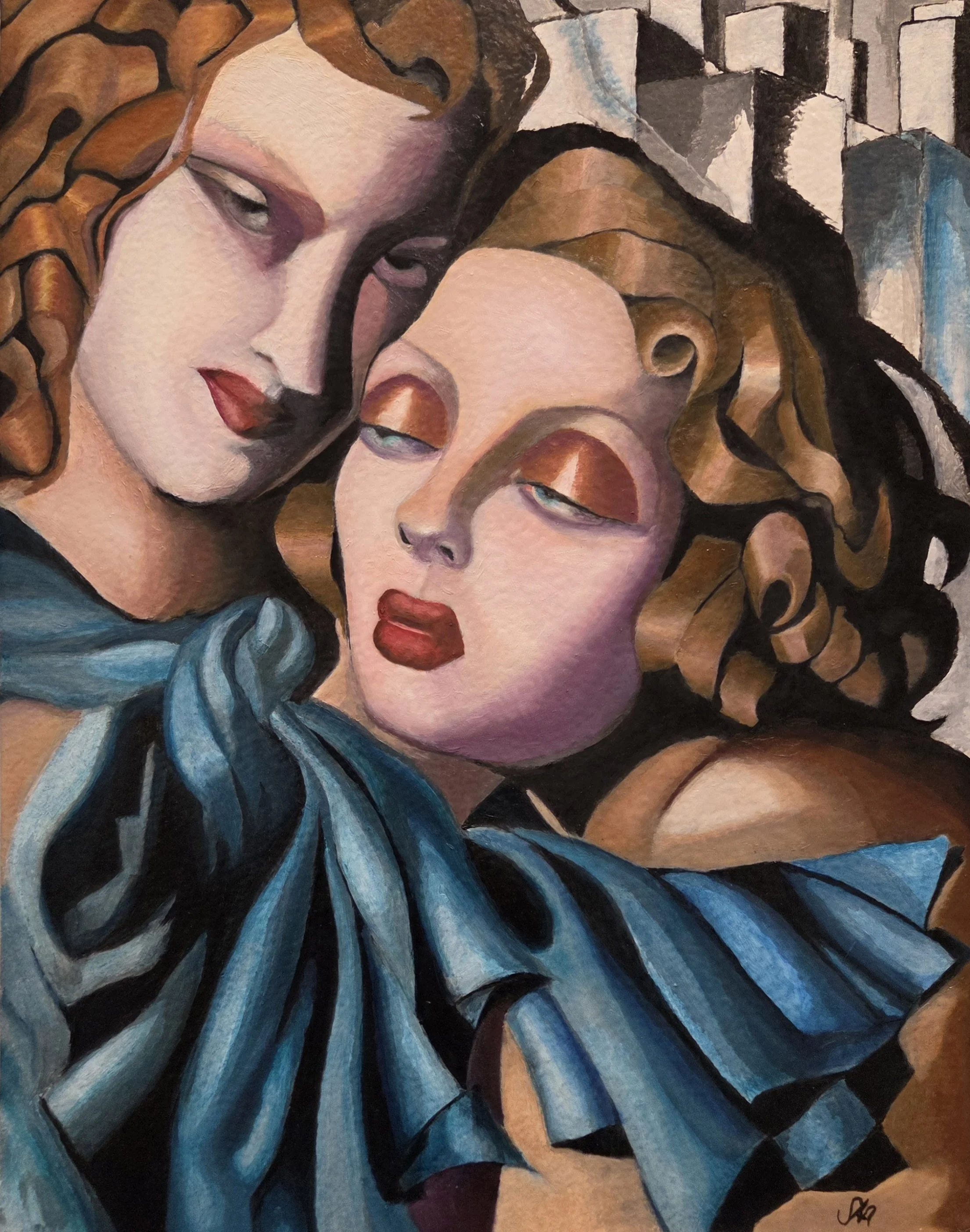
Young Ladies by Viktor Kiss
I began by glazing the dress. The glossy brilliant hue of the blue green was intoxicating forcing restraint to keep some areas muted with the thinnest of glaze.
Encouraged, I began painting the hair. Taking many approaches: mostly wet on wet where I would first paint bands of colour and with a long haired or filbert brush gently blend and pull the hues to suit. As I worked I would inevitably brush out of bounds prompting a chime in my head. “Know when you are adding or removing paint”, said Florent Farges on one of his Youtube videos. An obvious fact I needed to hear. Continuing on I would finish the area I was working on then wipe the brush a half dozen times to “clean” it and begin the cleanup. I removed unwanted paint wiping the brush and repeating as needed. The cleaned area generally needed a reapplication of its colour. Tighter precision meant fewer repeat cycles of this cleanup dance.
When viewing the painting it is very satisfying how the eye interprets the hair. Up close it is a collection of interesting shapes consciously perceived as hair yet fifteen feet away it flaunts a luxurious reality seemingly without conscious effort.
A note on brushes
I used a synthetic (Taklon) flat brush of about ¼ inch as my workhorse. I use the tip on either side to apply detail and the flat edge to apply and carve paint. I’m becoming accustomed to using a half dozen brushes for most paint sessions: A 0 or 1 round for detail, large flat brush, long haired brush for blending, a filbert for flattening and blending (especially from awkward angles), at times a hog hair to remove semi-dry paint.
Ecstasy of Saint Teresa
My introduction to Tamara de Lempicka began with a pencil and ink drawing that I called “Avila”. At the time I had kidded myself into thinking that I had somehow projected a greater sense of realism from Tamara’s Art Deco painting.
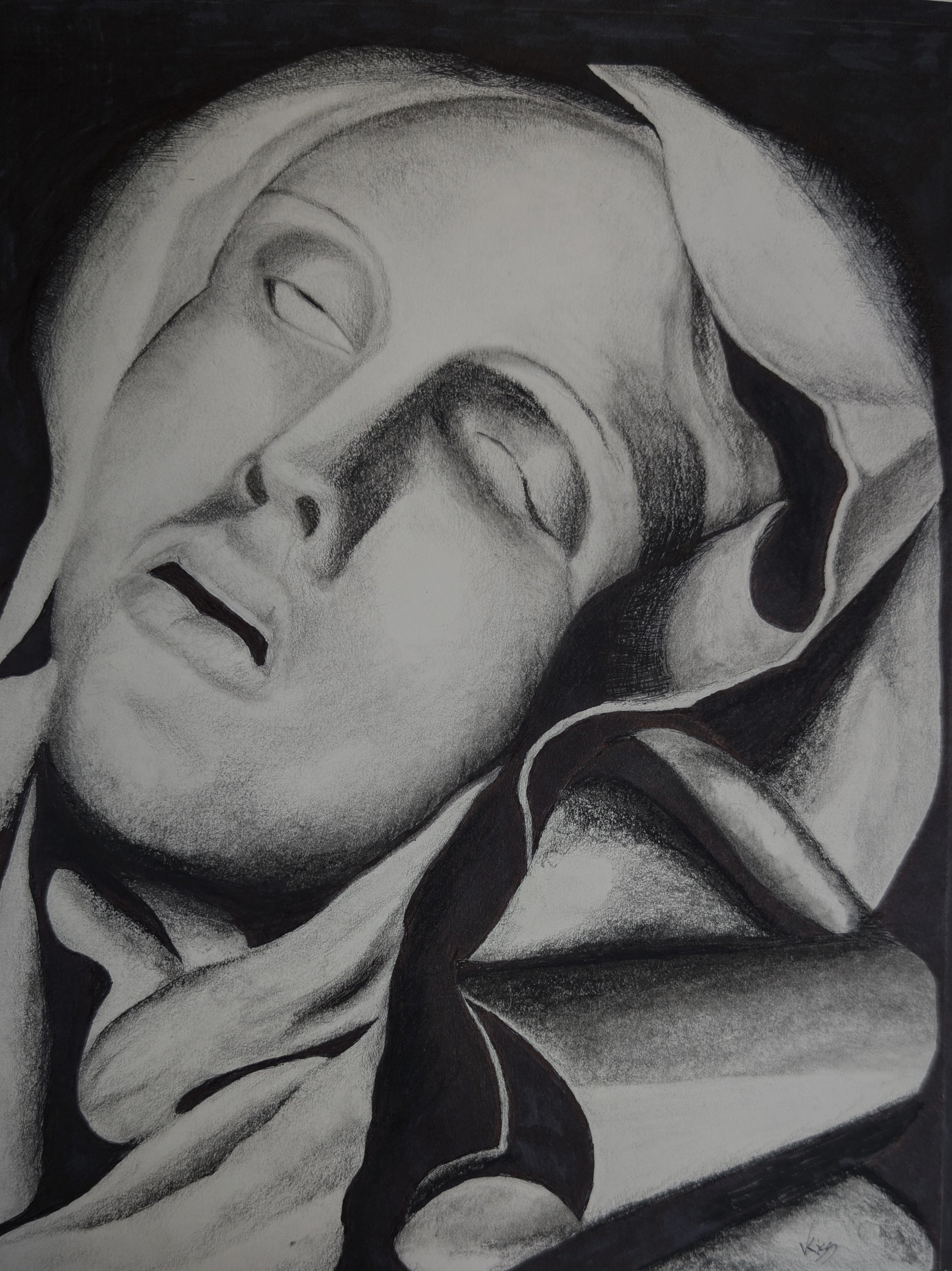
Avila by Viktor Kiss

Sainte Thérèse d’Avila by Tamara de Lempicka
